# Finding Your Perfect Fit: A Comprehensive Guide to Checking Your Ring Size
Discovering the correct ring size is crucial for ensuring both comfort and security when wearing your cherished jewelry. An ill-fitting ring can be a source of constant annoyance, whether it’s too loose and risks slipping off, or too tight and causes discomfort. This guide provides a detailed, step-by-step approach to accurately measuring your ring size at home, empowering you to make confident purchasing decisions, whether you’re buying a special gift or treating yourself.
Understanding the nuances of ring sizing can seem daunting, but with the right tools and techniques, it’s a straightforward process. Factors such as the width of the ring and the temperature of your finger can influence the fit, so it’s important to consider these elements for the most accurate measurement.
## Understanding Ring Sizing
Ring sizes can vary significantly across different countries and measuring systems. The most common systems include the US, UK, and European sizing. In the US, ring sizes are given in whole and half numbers, indicating the internal diameter of the ring in millimeters. For example, a size 7 is equivalent to 17.35 mm in diameter. The UK system uses a letter-based scale, while the European system uses a circumference-based millimeter measurement.
### Common Ring Sizing Systems
* **US System:** Sizes range from 3 to 13, with half sizes included.
* **UK System:** Sizes range from A to Z, with half sizes indicated by a “plus” sign.
* **European System:** Sizes range from 41 to 76, representing the inner circumference in millimeters.
### Factors Affecting Ring Size
Several factors can influence your finger’s size and, consequently, your ring size.
* **Temperature:** Fingers tend to swell in warmer temperatures and contract in colder ones. It’s advisable to measure your finger at a comfortable room temperature for the most accurate reading.
* **Time of Day:** Similar to temperature, fingers can be slightly larger in the afternoon or evening compared to the morning.
* **Ring Width:** Wider bands tend to fit more snugly than narrower bands. If you’re purchasing a wide ring, consider sizing up slightly.
* **Activity Level:** Exertion and physical activity can cause fingers to swell temporarily.
## Methods for Measuring Your Ring Size
There are several reliable methods you can use at home to determine your ring size. Each method requires a bit of care and precision to yield accurate results.
### Method 1: Using a Ring You Already Own
If you have a ring that already fits comfortably on the desired finger, you can use it to determine your size.
1. **Find a well-fitting ring:** Select a ring that fits the finger you intend to wear the new ring on.
2. **Measure the inner diameter:** Place the ring on a flat surface and use a ruler or caliper to measure the inside diameter of the ring in millimeters.
3. **Compare with a sizing chart:** Consult a printable ring size chart or an online tool to match your measurement to the corresponding ring size.
### Method 2: Using a String or Paper Strip
This method is useful if you don’t have a ring that fits the intended finger.
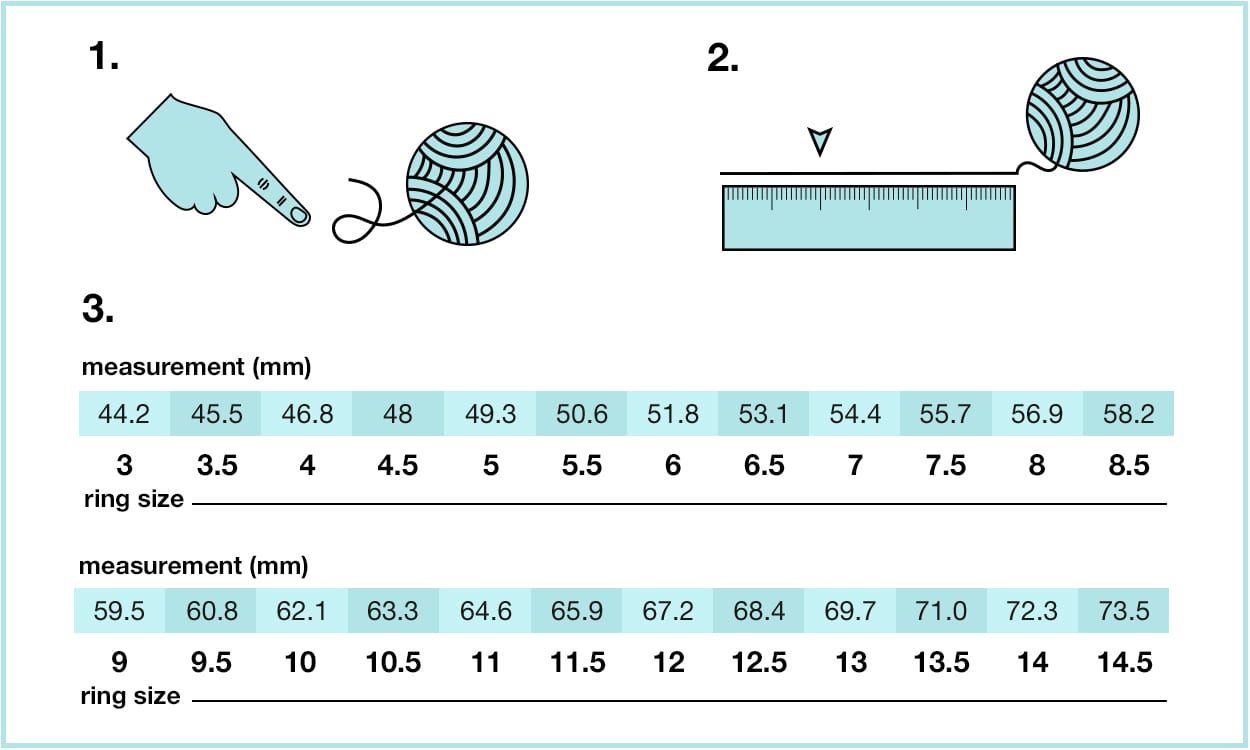
1. **Wrap a string or paper strip:** Take a non-stretchy string or a thin strip of paper and wrap it around the base of the finger where you’ll wear the ring. Ensure it’s snug but not too tight.
2. **Mark the overlap:** Make a clear mark on the string or paper where the end overlaps, indicating the circumference of your finger.
3. **Measure the length:** Lay the string or paper strip flat and measure the length from the end to your mark in millimeters. This measurement represents your finger’s circumference.
4. **Convert to ring size:** Use a ring size chart to convert your finger’s circumference to the correct ring size.
A common mistake is measuring the circumference of your knuckle instead of the base of your finger. Ensure you are measuring at the point where the ring will sit for an accurate fit.
### Method 3: Using a Printable Ring Sizer
Many online retailers provide printable ring sizers that combine a ruler and a sizing guide.
1. **Print the sizer:** Download and print the ring sizer at 100% scale. It’s crucial not to scale the printout to fit the page.
2. **Verify the scale:** Use a ruler to check that the printed scale on the sizer matches the actual measurements.
3. **Follow instructions:** The printable sizer will typically have instructions for either measuring an existing ring’s inner diameter or for wrapping around your finger and sliding a ring onto a designated sizing line.
## Tips for Accurate Measurement
To ensure the most accurate ring size, keep these additional tips in mind:
* **Measure at the end of the day:** Fingers are generally slightly larger in the afternoon or evening.
* **Consider finger swelling:** Avoid measuring when your hands are hot or cold, as temperature fluctuations can affect finger size.
* **Measure multiple times:** Repeat the measurement process a few times throughout the day to account for any natural variations.
* **Account for ring width:** If you are purchasing a wider band (5mm or more), consider going up a quarter to a half size, as wider bands tend to feel tighter.
* **Measure the correct finger:** The size of your fingers can differ between your dominant and non-dominant hand. Measure the specific finger you intend to wear the ring on.
The average ring size for women in the US is between 6 and 6.5, while for men it’s typically between 9 and 10. However, this is just an average, and finger sizes vary greatly among individuals.
## Frequently Asked Questions (FAQ)
**Q1: How do I choose the right size if my finger size fluctuates?**
A: It’s best to size for the largest circumference of your finger, including the knuckle. This ensures the ring will pass over the knuckle. If the band is very wide, you might consider sizing up a half size to accommodate the snugger fit.
**Q2: Can I use a standard ruler to measure?**
A: Yes, if you are measuring the inner diameter of an existing ring. For measuring finger circumference, a flexible string or paper strip is more suitable, and then you would use a ruler to measure that string or paper.
**Q3: What if I’m between sizes?**
A: If you find yourself between two sizes, it’s generally recommended to size up, especially if you are considering a wider band. A slightly larger ring can often be made smaller by a jeweler, but a ring that’s too small may not fit at all.
**Q4: How does the width of the ring affect the size?**
A: Wider rings fit more snugly. For bands that are 5mm or wider, it’s often advised to go up a quarter to a half size compared to what you would select for a narrow band.
**Q5: Is it better to measure my finger when it’s warm or cold?**
A: Measure when your finger is at a normal, comfortable temperature. Avoid measuring when your hands are very cold (fingers are smaller) or very hot (fingers are swollen).
## Resources
For further assistance and to explore international sizing conversions, please refer to reputable jewelry websites that offer detailed sizing charts and guides. One such authentic resource is:
* [The Jewelry Exchange – Ring Sizing Guide](https://www.thejewelryexchange.com/ring-sizing-guide)